The Tonal Functional System
From DIMA
Autor : Constantin Rîpă
|
THE TONAL-FUNCTIONAL SYSTEM (THE TONALITY)
"Tonality can only be conceived harmonically."
C. Rîpă
The tonal-functional system is the system used by the musical creation of the three great stylistic periods, i.e. the Baroque, classicism, and Romanticism; these were the periods in which the grandest of musical works were accomplished. It is therefore the tonal system that was used by Vivaldi, Bach, Mozart, Rossini, Beethoven, Chopin, Berlioz, Verdi, Liszt, Wagner, Brahms, R. Strauss, and their contemporaries.
Genesis
In the lessons on the tonal system of the Renaissance (the polyphonic modes), sufficient elements have already been pointed out with regard to the direction its evolution towards a new system: the functional system. However, the issue needs to be brought up again, in order to establish a definitive clarification, because in the treatises and school textbooks one often reads that the Ionian and Aeolian modes (from the Middle Ages) became the major and minor scale of the tonal-functional system. The idea is not only erroneous, but it is also a source of confusion for the evolutionary process of the tonal systems. That is why, in what follows, the trail of the formation of the system of tonalities will be retraced, in accordance with musical practice.
It has been pointed out how, in the course of the process of evolution, especially due to the internal and final cadences, the polyphonic modes began to resemble one another. Thus, if one compares the modes based on a major third, that is, the Mixolydian, the Lydian, and the Ionian, and taking into consideration the cadential alterations and the infiltration alterations (naturale-molle), one will notice a striking resemblance among them, both in terms of melodic and harmonic content:

The same phenomenon occurs in the case of the 3 minor modes – Dorian, Phrygian, Aeolian:

Thus, a process of equalization occurs, in that the major modes form one unit, while the minor modes, a separate unit. Consequently, the tonal-functional system is formed through the binary synthesis of the modal system of the Renaissance. The three major modes (of C, of F, and of G) turn into three major tonalities, namely C major, F major, and G major, while the three minor modes (of D, of E, and of A) become three minor tonalities: D minor, E minor, and A minor.
These are therefore the tonalities (major and minor) encountered with the first of the Baroque composers, Monteverdi and G. Gabrieli, to which were added B-flat major (the old Lydian genus molle) and G minor (the Dorian genus molle). The other tonalities will be acquired in the course of a process that will go on for about two centuries.
Renaissance music literature also confirms the fact that it is not the Ionian and Aeolian modes that are the most widely used, but rather the Mixolydian and the Dorian. Thus, these may be considered to be the central modes. With the first Baroque composers, the tonalities G major, B-flat major, D minor, and G minor are more frequent than C major and A minor. In fact, the Ionian and the Aeolian behave in the musical creation of the Renaissance like any of the other modes: they adopt modal harmonic successions in the polyphony of the Renaissance and become tonalities by acquiring the functional attributes (at the same time as the other modes) as the Baroque draws closer.
Other elements that confirm the evolution can be seen especially in the minor tonality, whose variants conserve modal structures (Phrygian, Dorian, Aeolian).
Thus:
- the natural minor keeps the Phrygian tetrachord:

- the melodic minor retains the Dorian cadential aspect:

- the harmonic minor is born from the (cadential) leading note of the Aeolian mode, and especially from the meeting, within the Dorian mode (B flat-C sharp), of the molle alteration with the leading note:

In the crucible of the modal creation of the Renaissance is also prepared the phenomenon of tonal modulation through that procedure of cadencing on different steps of the mode.
Here are some arguments through which the major and minor scale (the major and minor tonalities, to be more precise) does not mean the enthroning of the Ionian and Aeolian, but rather an evolution of the entire modal complex towards the new system, the tonal-functional system (or, the system of major-minor tonalities).
The whole process of evolution is driven by the cadence phenomenon, based in its essence on the principle of functionalism, principle meant to ensure the gravitation towards the chord having the greatest stability – namely that of the tonic.
The role of functionalism
Functionalism will direct the evolution of the four principal elements of the musical discourse: a) harmony, b) melody, c) forms, d) rhythm-meter. In what follows, the role of functionalism in each of these elements will be succintly deal with.
- Harmony
The system of tonalities was shaped as a result of the development of functionalism, that is, the development of the taste for the harmonic cadence, which represents the succession of two chords that are in an instability-stability relationship (in which the leading note plays the main role through its acute tendency for resolution). This relationship will chiefly mean the dominant-tonic (D-T) succession.
The tonic (T) becomes the ideal of stability. Once this ideal is established, however, the process does not stop, T starts to expand its attraction not only on the dominant, but also on a whole chain of chords, that is, on a broader cadence. In order for this attraction of T not to be hampered, certain measure are taken, in the shape of the laws (rules) of harmony, laws that Rameau expounds in his Treatise on Harmony (1722). Thus, a new conception on composition appears, which mainly traces the succession of chords, and not the polyphony of the voices with vertical consonance-dissonance relations, unlike in the Renaissance, where the cadence (D-T) intervened only at ending an (imitative) segment.
But the laws of harmony, too, were formed in the course of time.
At an initial stage, the functional harmonic "triad" is established: subdominant-dominant-tonic (S-D-T), which becomes manifest in the chords of steps IV-V-I, also called principal steps. If one analyzes this triad from the perspective of the idea of gravity, the question arises: what is the role of S, because it does not tend to resolve on D. That is why, in order to understand the role of S, the formula must be completed with T-S-D-T
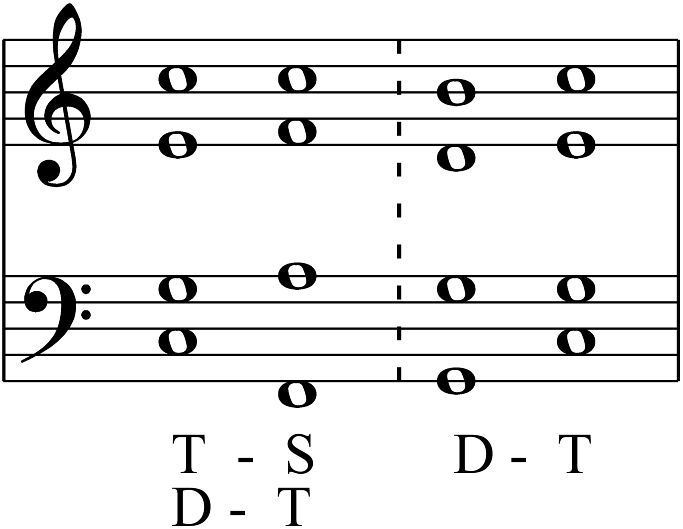
The expression built in this manner is a binomial with two polarities: T-S and D-T. The succession T-S is (through the third of the tonic as a leading note) a relation between D-T. Consequently, the task of D is to return everything towards T. Consequently, the role of S is one of contrast, in order to accentuate the efficiency of D. Often, the harshness of the contrast is attenuated by the use of S with an added sixth ("Rameau’s sixth," in fact II6/5), and, later, by the minor subdominant with a lowered third:
 , as well as by the Neapolitan sixth chord, which has dominant attributes from the modal Phrygian cadence (descending leading note)
 .
.
As the sense of gravity develops, D is gradually no longer preceded by the burden of S, but rather by a new function: the counterdominant or the dominant of the dominant (DD), that is, a chord that will resolve on D:
 .
.
This is the chord of the second step with an ascendingly-altered third (leading note to the fundamental D). In this manner, the functional fluency is ensured: DD gravitates towards D, and D gravitates towards T. In order for the DD chord to tend towards D, it is often not only the third that will be altered, but also the other sounds of the chord, in order for them to become leading notes (ascending or descending) to one of the sounds of chord D, to which a seventh and a ninth will also be added. Being a sum of the natural and altered steps, the chord becomes a conglomerate
 from which several chordal formations of 3, 4 sounds may be extracted, situation in which it may also become an altered step IV chord:

Sometimes DD resolves on I64 (K64), in which case it may acquire the following alterations as leading notes:
 .
.
This way, the DD chord contains a total of 13 sounds (natural and altered), with the exception of the fundamental D (G).
Starting with classicism (Mozart), the DD chord will play an important role in the evolution of the tonal-functional system. Because, based on the principle by which a DD
is obtained through the alteration of the elements of the chord of step II, by way of extension, the chord of any step of the tonality becomes receptive to being altered (sensibilized) and transformed into a D in order for it to resolve on a T, but the chord of this T may be altered at the moment of resolution and, in turn, transformed into a D for a new T, and so forth:
Beethoven: Sonata Op. 2, No. 2, III
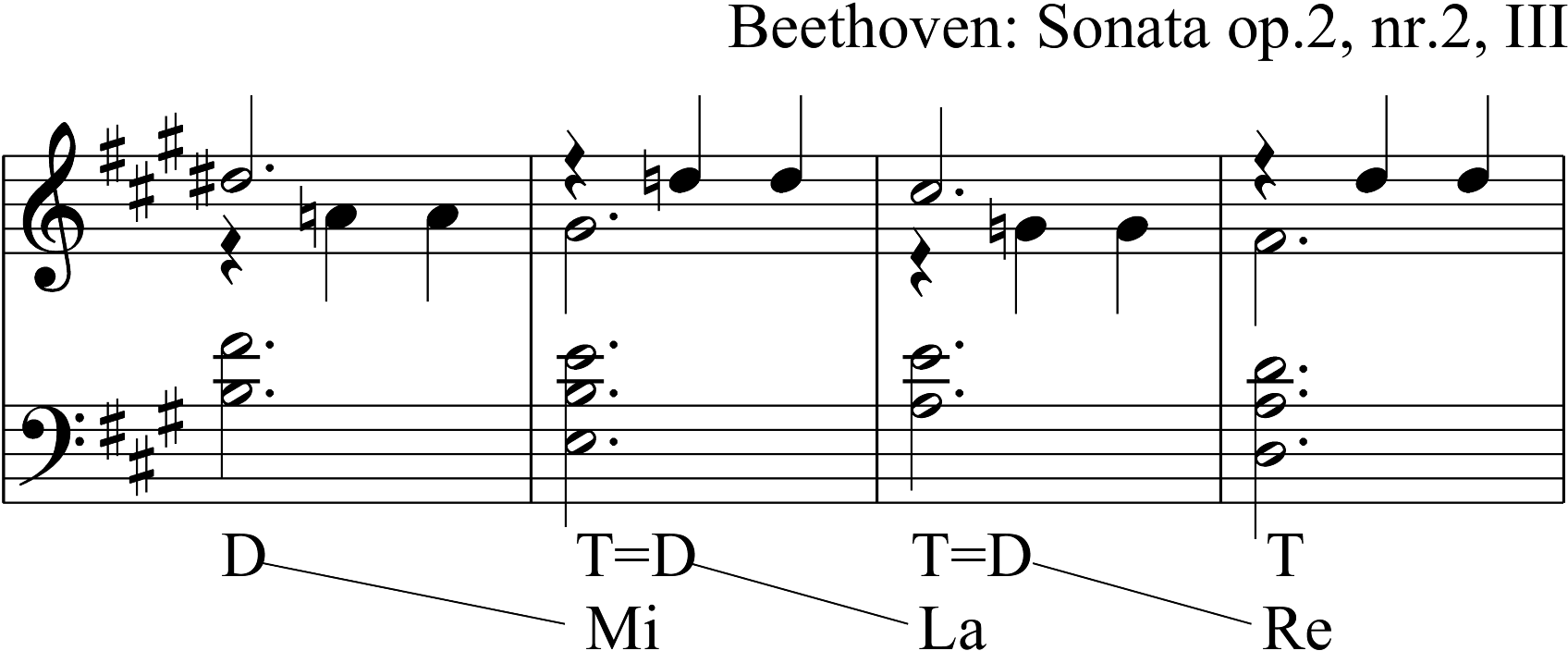
DD thus opens the procedure of obtaining altered chords, and chromatic inflections and modulations. The phenomenon is taken to the next level by the late romantics (Liszt, Wagner), through the permanent chromatization of the chords, especially in a dominant sense, in which their resolution is always delayed, and T becomes a "floating" note, in that it is apparent from a subjective point of view, when in fact it is nonexistent:
Wagner: "Tristan and Isolde," Prelude (Bars 27-32)

Of course, there is a multitude of other petty regulations (which are being taught as part of the Harmony course) that favor functional gravity. Among them, a harmonic rule that became established at an early stage excludes the succession V-IV (D-S) and eliminates step III, whose function is uncertain due to the incorporation of two important sounds of the T chord and two of the D
 ,
,
that is, of the main chords that contain the essence of the tension-resolution balance (i.e. the functional essence).
By synthesizing the harmonic functions of the tonalities and their representation by the chords of the different steps, the following table ensues:
| Function | Step | Replacement steps |
| 1. Tonic 2. Dominant (D) 3. Subdominant (S) 4. Dominant of the dominant (DD) | I V IV II3# | VI (III) VII (III) II (VI), IIb=SN IV#3 |
The succession of the chords, determined by their harmonic function, becomes the essence of the musical discourse in the system of tonalities (of the Baroque, classicism, Romanticism). This succession is expressed by the harmonic cadence. But unlike the modal harmony of the Renaissance, in functional harmony the succession of chords is permanently organized in cadences. Thus, the entire creation of the Baroque, of classicism, and of Romanticism is a continuous process of cadencing. By means of these cadences, the functional harmony involves (as will be shown at a later point) all musical parameters.
Thus, we can only view tonality from the perspective of harmony:
- Melody
Functionalism will impose on the melody a trimming of its configuration and, at the same time, it will formulate new specific melodic manners.
Functional structuring refers to two aspects: 1. the organization of the melodic movement, and 2. the morphological and syntactic organization.
1. As far as the organization of the melodic movement is concerned, functionalism will gradually demand of the melody a coercion for the vertical incorporation in chords on the one hand, and a substitution of certain successions of neutral sounds for others sounds which promote the spirit of the leading note of the harmonic cadence, on the other hand. An example of such functional coercion is offered by the melody "Dies irae," which, in its Gregorian form, looks like this:

while, at a later point, with Berlioz, it looks thus:
Berlioz: "Fantastic Symphony," p. V

(N.B. The cadence is constituted and the tendency of the resolution on the C tonic is intensified, which, in this manner, is instituted retroactively upon the whole theme.)
As far as the promotion of the spirit of the leading note is concerned, the motif from "Ohimè il bel viso" by Monteverdi comes in handy:
 , and which is encountered in reverse form with Bach:
 , having been derived from the usual Gregorian melodic movement:

The formulation of new melodic manners refers to the fact that the unfolding of the melody involves the inclusion in itself of the harmonic functions. The phenomenon is achieved in several ways:
- it (i.e. the melody) is structured on scale aspects between 2 chordal pillars in a T-D or D-T relation:
Beethoven, Sonata Op. 2, No. 2

- it covers the chord scheme via an arpeggiated movement:
Mozart: Piano Sonata KV332

- it adopts sequential successions regarding the evolution from an important function to an important function (T or D):
Bach: Fugue in A minor, organ

- it is ornamented on the frame of one or more functions:
Mozart: Piano Sonata KV135

2. The morphological and syntactic organization implied by functionalism involves the melodic structuring into sections having an identity status. Thus, the morphological figure and motif patterns emerge, as well as the
phrase and period syntactical patterns, while the large forms, i.e. lied, sonata, rondo, variation, fugue, etc., are built in extensor.
The melodic figure (the cell, the submotif) is uttered in support of the respect for functions: T-D (a), in order for the motif to become complete again when coupled with its reverse D-T (a1):

The melodic phrase and period are delimitated according to the harmonic cadence principle, and the modulatory relations within the large forms involve the structuring of the melodic discourse into a permanent dependence on tonal-functional thinking.
The process of the functional organization of the melodic parameter, however, traverses historical stages whose distinction outlines the three great styles: Baroque, classical, Romantic.
In its early stages (Monteverdi, G. Gabrielli, etc.), the Baroque style reveals the subsistence of a modal melos that is intertwined with the functional one, which is in the making. Thus, if a melody such as this one:
Monteverdi: "Io mi son giovinetta"

has preserved intact the modal contours (melodic movement), the next melody, by Monteverdi again, on the other hand, follows the new functional harmonic outlook:

The evolution is fast, however, and the spirit of the dance, in which Baroque instrumental music develops, tends towards ever more categorical functional formulations (scale, arpeggio, sequence), so that in the middle period of the Baroque (Vivaldi, Corelli, A. and D. Scarlatti, Couperin, Rameau, Purcell, Buxtehude, etc.), the melodic line becomes unequivocally functional:

The melodic typology of Händel and Bach, representatives of the late Baroque, reveals the state of a closed process, the linear coordinate being subjected almost totally to the vertical harmonic principle:
Bach: Fugue in E minor, organ

Classicism becomes the exponent of functional purity. The classical melody itself is often harmony. The melody scale between harmonic pillars, so frequent, involves the extreme case of certain musical segments etched entirely on the scale:
Mozart: Piano Sonata K.V.545, I

and the arpeggiated melody reaches an extreme case in the "Alberti bass:" Mozart: Sonata in C major, K.V.279, I

Sometimes, the melodic linear component and the harmonic vertical component become involved to such an extent in the cadencing process that they are in fact impossible to separate:
Beethoven: Sonata Op. 10, No. 1, 1

(N.B. It is truly astonishing that this theme of Beethoven’s, which is of such great expressive force, is made up in its entirety only of the cadencing with two functions, T and D.)
Early Romanticism (Schubert, Weber, Mendelssohn, Rossini, etc.) does not detach itself from classicism. On the other hand, middle Romanticism (Schumann, Chopin), and especially late Romanticism (Liszt, Wagner, Brahms), accentuate to the highest level the process of dominantization by the permanent alteration (sensibilization) of the chords, situation in which the resolution proper (the stability) is always delayed.
The emergence of the composers of the national Romantic schools (Grieg, Chopin, Smetana, etc.) heralds, however, certain attempts at modal intuition, but not the previous medieval modal, but rather the modal of the peoples they represent. These intuitions still remain constrained by a strict functional harmony. Modal thinking, vaguely foreshadowed again at the level of the two dimensions (melody, harmony), may be noticed in the case of Liszt and especially Mussorgsky. Here is this moment from Pictures at an Exhibition, in which the avoidance of the D-T succession by using the chords of the secondary steps creates a sound ambiance different than the functional one:
No. 10

By the inclusion of the harmonic tensions, the Baroque-classical-Romantic functional melody acquires a certain eloquence which markedly sets it apart from the preceding modal melody, so that it now becomes the main bearer of expressive content.
- Forms
Harmonic functionalism, through its cadencing system and through its tonal relations, permanently structures the musical discourse. The harmony becomes a creator of form, from the cellular level all the way to the great constructions such as the fugue, the sonata, the rondo, etc.
Formal structuring occurs on three levels:
1. the formulation of the morphological elements (figure, motif),
2. the syntactic organization (phrase, period, lied),
3. the establishment of the tonal relations within the large forms (fugue, sonata, rondo, variation, etc.)
1. The issue of the formulation of the morphological elements – i.e. figure, motif
by harmonic cadential conditioning has been dealt with before, within the melody. However, harmonic motifs can also be indicated:

2. The syntactic organization of the musical discourse into phrases and periods is compelled by the same functional logic. That is why the determination of the dimension of the musical phrase and of the period is accomplished according to the harmonic cadence. Thus, phrase I often adopts a ending with an imperfect cadence (step I6) or a semicadence (cadence on D - i.e. the dominant), while the period is marked by the perfect cadence (step I direct state in the base tonality or in the modulating one):
Beethoven: Sonata Op. 2, No. 1, II

The lied, formed from two or more periods, often also involves a relation between two tonalities, usually: period I (A) in the basic tonality, while period II (B) involves the tonality of the dominant (or of the relative), only in order for the reprise (A1) to re-establish the initial tonality.
3. From an early stage, the tonal relations constitute the basis of the development of certain grand forms. It is known how the fugue established the indestructible T-D relation between theme and response within the exposition, only for the meddle reprises to then unfold in close tonalities, the ending being accomplished by a reprise in the basic tonality. The sonata, which is the most characteristic form of the functional system, involves the thematic antithesis via a T-D relation (at a later point evolved also in the case of other tonal relations) within the exposition, only for the two themes to align themselves in the base tonality at the end, in the reprise, after several tonalities will have been traversed in the middle part – treatment. Similarly, al other forms used by the three musical styles (variation, rondo, the large tripartite forms) are conditioned by the tonal relations within their own structures. And it is still the tonal relations that unify the component parts of the cycles (suite, sonata-symphony-concerto, divertimento, etc.).
The tonal cohesion thus lends logic to the vast plan of the instrumental works which, in the absence of a literary text, needs structural elements based on another principle. This principle proved to be that of the functional harmonic cadence.
- Rhythm-meter
The succession of the chords with the instability-stability and tension-resolution relation, respectively, automatically also engages the perception of certain unstressed-stressed relations, imposing the concept of meter in this manner. The harmonic periodicity thus also offers a metric periodicity:
Mozart: "A Little Serenade"

If in the Baroque a certain freedom in organizing the phrases and periods still persists, classicism imposes the spirit of squareness by precise dimensioning: phr. I 4 bars + phr. II 4 bars = 8 bar period (called the "classical period"), everything being determined by the harmonic cadence.
Consequently, the meter proper, as a stressed-unstressed periodicity, is born at the same time as the functional system. This periodicity imposes the binary and ternary meter, eliminating other rhythmic-metric categories (the mixed meter, free rhythm, etc.).
The establishment of the metric concept results in a strict organization of rhythm on its own beats. The rhythmic formulas (organized according to metric beats and comprised within a bar) are defined strictly as a dimension. Thus, a limited lexicon of binary and ternary rhythmic formulas takes shape, with which the entire Baroque, classical, and Romantic creation operates.
As a particular phenomenon, one may signal the anacrusis principle, which is born within tonal music, again based on the harmonic D-T (or T-D) relation in the incipit formulas:
Mozart: Piano Sonata KV 576, I

From the exposition of the effects of functionalism upon the basic elements of the musical discourse (harmony, melody, forms, rhythm-meter), emerges the role of the its coordinates in the establishment of certain general stylistic aspects for the three musical eras – the Baroque, classicism, Romanticism
Tonality, scale, chord
Musical theory established several notions through which the content of the tonal-functional system is expressed. Among these, the notions of tonality, scale, and chord are the most important and most customary.
The notion of tonality was defined in an abstract manner, as a principle, as a law of the functional system, according to which the sounds and chords of this system converge (gravitate) towards a single center – the tonic.
In fact, the tonality is actually the frame within which the process of melodic and harmonic succession unfolds, based on the functional relations.
Thus, tonality provides the building blocks for musical works.
The tonal-functional system is made up of several tonalities, which, in theory, are obtained by the transposition on the scale of the fifths (ascending and descending) of the C major (for the major ones) and A minor (for the minor ones) tonality, respectively. Thus, a string of tonalities is obtained, of which 30 (15 major and 15 minor) are customary, while the rest remain theoretical.
This string of tonalities may be presented in the order of the fifths (ascending and descending) as follows:

From this scheme follow certain relations and practical utilities:
- the relation of the relative, between the major and minor scale, which are two scales with the same key signature,
- the distances of the fifths between the tonalities, signifying community relations,
- the enharmony of the last three pairs, proving the fact that in fact there exist only 24 tonalities.
Except for these evidences, between the tonalities there exist many other (especially modulatory) relations, which will be dealt with separately.
Tonality materializes in the scale and the chords.
The scale represents the diatonic scheme of tonality. The sounds of the scale and its structure reflect the basic harmonic structure of the tonality (T, S, D):

The conjunct order by which the scale presents the sounds of the tonality has its tradition in the modal theory of the Renaissance. The graphic visibility of the scale and its tactile perception (in the case of instruments) caused music theory and practice to use the scale of modes and, later, the scale of tonalities, as a genuine algorithm for the acquisition of theoretical and practical knowledge. The scale thus became the model scheme for the study of tonality. Its practical usefulness imposed it, however, on musical thought (especially in the case of keyboard instruments), lending it an important role in the melodic constructions.
Each tonality is represented by its scale. Thus, there are 30 scales (15 major and 15 minor) in practical use.
The chord is generally defined as the superimposition of several sounds.
The chord used by the functional system is, however, the triad, created by the superimposition of thirds. It was born within the polyphony of the Renaissance, which took into account the idea of vertical consonance. Thus, the chords (triads) were formed from perfect consonances (fifth, octave) and imperfect consonances (third, sixth).
The tonal-functional system took over the four triad types (major, minor, diminished, augmented) of the Renaissance, enriched them partially (with a seventh and a ninth, or with altered forms), and assigned them functions (T, S, D, DD).
The tonality, the scale, and the chord thus represent basic notions of the tonal-functional system.
The tonality, representing the frame within which the chords link up according to the rules established by the functional necessities, has a sound content that is much richer than its diatonic scheme (scale) reflects – the scale. It is not only the alterations used by the chords that contribute to this content, but also the alterations used as melodic notes (changing, passing, etc.), while any tonality offers the possibility of using its chromatic total.
Alterations and chromaticisms in the tonal-functional system
In the tonal-functional system, the exclusive law for the occurrence of alterations and chromaticisms is (functional) attraction based on the leading (sensible) note principle. This attraction will be directed in the first place by the more stable sounds represented by the chord of the tonic.

Leading notes for the sounds of the chord of the dominant, of the step VI chord, and of the subdominant, will also be achieved based on this model:

There is, however, an historical order in the acquisition of alterations and chromaticisms, according to the evolution of the tonal-functional system, from the Baroque to classicism and then to Romanticism, as well as a certain specificity and density that vary from one style to another.
Before dealing with this order and particular-stylistic specificity of the use of alterations and chromaticisms by each era, an important aspect needs to be clarified, and namely, the fact that, within the tonal-functional system, alterations may play the role of:
- a melodic note (delay, passing, changing, anticipation, échappée);
- a harmonic function, achieving:
- an altered chord
- modulatory inflection
- modulation.
In the process of musical creation, the altered melodic elements often participate in functional orientations in the resolution of the chords, in this manner achieving a collaboration between the melodic alterations and the tendency of the harmonic resolution:
Bach: Brandenburg Concerto No. 1, II
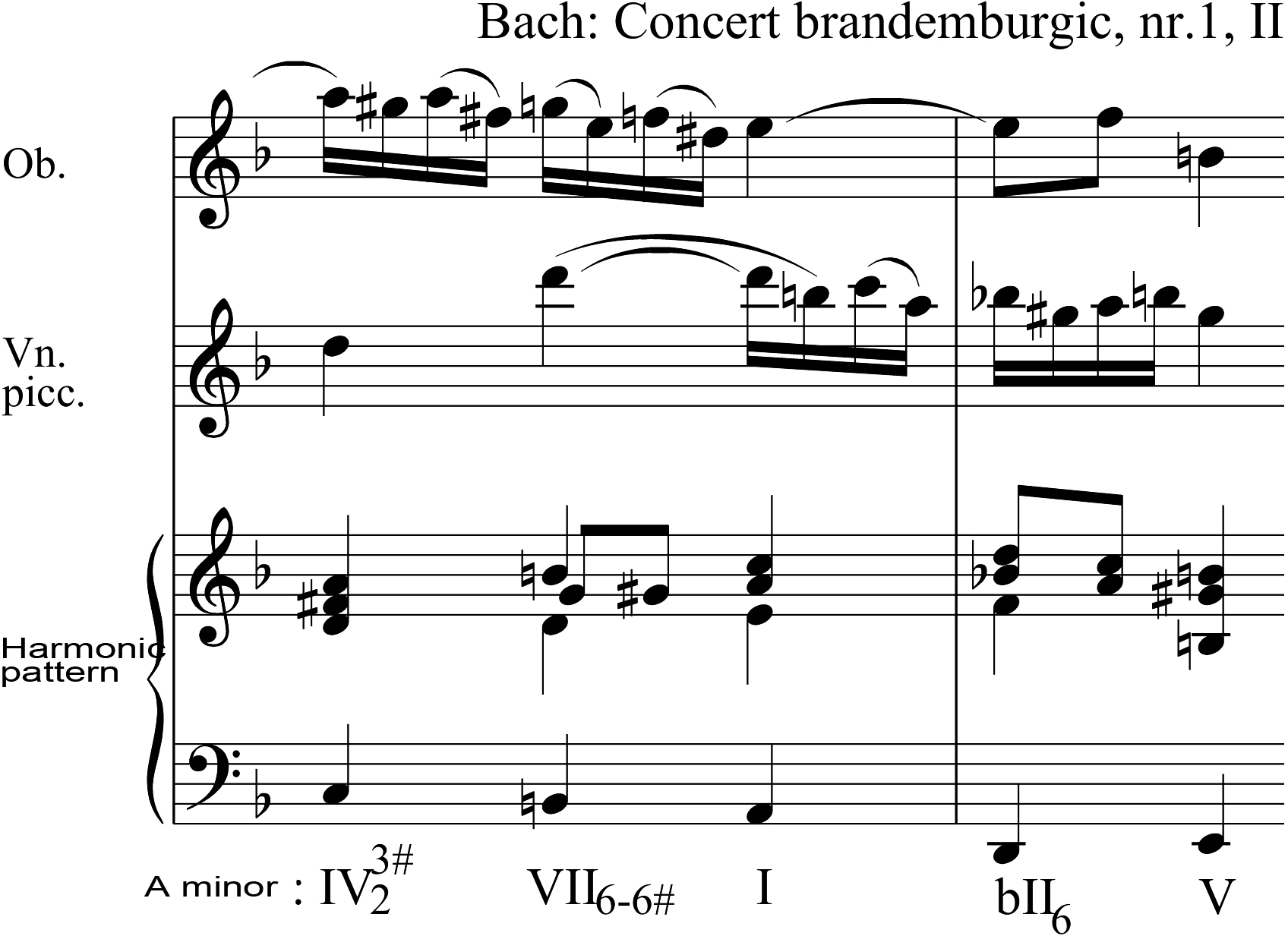
(N.B. The oboe’s D sharp creates a melodic leading note for E (changing note), but it also stimulates the resolution of chord VII6 (through the ascendingly-altered sixth), on step I. The violino piccolo’s G sharp in the next bar plays the same role.)
Let us move on to the analysis of the issue of alterations and chromaticisms, according to style.
To a large extent, the Baroque inherits the cadential alterations of the Renaissance polyphony, process in which, however, it directs towards a strengthening of the position of certain steps, which become the backbone of the tonality. Consequently, the Baroque alterations that are more frequent in the major tonality will be satellite leading notes to the following sounds, a base for chords:

only to then also add (less frequently) the leading notes of certain more stable sounds from the respective chords.

Consequently, the frequent alterations of the Baroque are: step IV altered ascendingly (F sharp), step VI altered descendingly (A flat), step VII altered descendingly (B flat), step V altered ascendingly (G sharp), and step II altered descendingly (D flat - Neapolitan). The less frequent alterations are: step I altered ascendingly (C sharp) and step III altered descendingly (E flat), and, very rarely, step II altered ascendingly (D sharp).
Therefore, a Baroque major tonality has the following chromatic content:

The minor tonality displays certain differentiations as compared to the major one. First, the superior tetrachord, which (as a result of modal heritage) retains three variants (natural, harmonic, melodic), may become chromatic by the varied use of these alternating natural and altered steps:
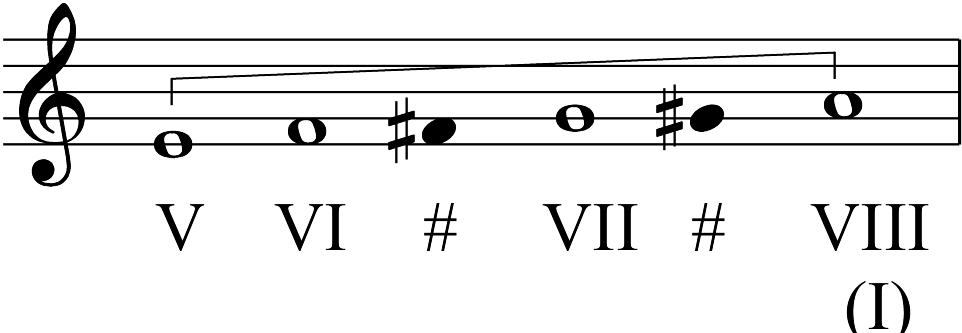
The chromaticisms in this tetrachord will remain invariable in both classicism and Romanticism. The inferior pentachord, however, adopts the same alterations as the major one (in which only the inversion of the third and the rare occurrence of step I altered ascendingly are different):

As far as the role of the alterations is concerned, the Baroque presents the following situations:
- Melodic role:
- changing, usually inferior note,:
Bach: W.Kl., II, Prel. in C minor

sometimes introduced by a leap, as in the case of the example from the Brandenburg Concerto by Bach (the oboe’s D sharp minor)
- passing note, often also influencing the function of the chord vertically:
Bach: W. Kl., I, Fugue in C major

- delayed note, descending
Bach: W. Kl., II, Prel. in F minor
 and ascending:
Bach: BWV 988, var.25

b) Harmonic function:
- altered chord
Bach: Fr. Suite IV, Allemande

- inflection:
Bach: Fr. Suite I, Allemande

- modulation.
As far as the abundance of alterations and chromaticisms is concerned, the Baroque, despite the fact that it departs from a stage as chromatic as that of Gesualdo and Monteverdi, does not continue it. As an initial stage of the functional system, the Baroque reverts to an authoritarian diatonism, the alterations and chromaticisms being used sparingly. Thus, the broadest frame of a chromatic progression (melodic or harmonic), most frequently descending, is either the superior tetrachord: Bach: Inv. in 3 voices in F minor

or the inferior pentachord:
Bach: "Musical Offering"

There are also some group alterations that create chromatic oppositions in small spaces, such as the formula of the melodic tetrachord of the dominant (in opposition to the natural one):
Bach: Organ Works, vol. VI, no. 15

and the alterations of the Phrygian tetrachord that has intervened in the superior tetrachord of the major scale:
Händel: "Jephtha"

The most advanced Baroque chromatics is to be found in J.S. Bach’s work, but it is always lodged between harmonic pillars and led with a strict functional logic. Even a passage such as this one:
Bach: W. Kl. I, Prel. in D

which may seem improvisational, has a precise direction (being initiated on the counterdominant and descending sequentially towards a precise "landing" spot – the tonic).
Classicism preserves the acquisitions of the Baroque, bringing about certain instances of quantitative but especially qualitative enrichment. The instances of quantitative enrichment consist in the higher frequency of step I altered ascendingly both in major and in minor:
Beethoven: Sonata Op. 2, No. 1, III

in the occurrence of step VI altered ascendingly in major (sporadically):
Mozart: Piano Sonata K.V. 331, II, var.

and in the occurrence of step V altered descendingly in major:
Beethoven: Sonata Op. 81, I

A classical chromatic scale comprises the following sounds:
- in the case of a major one:

- in the case of a minor one:

The qualitative value of the alterations in classicism has in view the new stylistic investment. This investment, starting with the altered melodic notes themselves, means, in the first place, the intensification of the leading note principle and thus the intensification of the compelling force of the tonality. Classical tonality reaches the apex of functionalism precisely via this continuous tension-resolution process (D-T) on a melodic and harmonic level. As shown above, any of the steps of the tonality may have an inferior and a superior leading note:

As in the case of the Baroque, the role of the alterations is: a) melodic, b) harmonic.
- The melodic notes, based on the leading note principle, engage tension charges thus:
1. the altered changing note, especially the inferior one, does not stand out so much in its customary usage (prepared and resolved):
Beethoven: Sonata Op. 2, No. 3, I

as it does in the situations where it is introduced via a leap:
Beethoven: Sonata Op. 10, No. 1, I

and where the resolution is achieved via a leap: Mozart: K.V. 545, III
 .
.
It also occurs in the (double) chordal figuration:
Mozart: Piano Sonata K.V. 533, V

2. the altered passing notes acquire a specific melodic flexibility (especially in the case of with Mozart), which is very well expressed by the phrase "sliding chromaticism" (J. Chailley). From the small passages: Mozart: Div. No. 16

to the over-two-octave dimension (as is the case in the Sonata Op. 13 by Beethoven, the connecting moment between the slow introduction and theme I), the chromatic passages are almost always present in the moments of junction and retransition from the structure of the classical forms;
3. the delayed altered notes receive the stylistic value of some melodic
harmonic accents, through their unprepared use (appoggiaturas) in time values that often exceed that of the real note of resolution:
Mozart: Piano Sonata K.V. 279, I and Beethoven: Sonata Op. 22, II

The resolution tension contained horizontally and vertically by these altered delays will be used excessively by the romantics.
- From an harmonic point of view, the alterations used by the classics promote the chord in a new function, usually a dominant function (D or DD). The chord on any step of the tonality may be altered (simple, double, or triple) and converted via these leading notes (ascending or descending) to a resolution. There is, however, a certain economy that maintains a balance between tension and resolution, a specific classical balance, which renders relative the chromatic density of the harmony of the classics.
The alterations of the chords have the same purpose as in the Baroque: an altered chord within the tonality, having an inflection function, and modulation.
Romanticism deepens the spirit of sensibilization, realizing not only ascending and descending sensible (i.e. leading) notes on every step of the scale, but also pushing the sensibilization process still further, using altered leading notes for altered leading notes:

Conceiving the phenomenon as being extended to all the steps of the scale, a scale is obtained, in which each diatonic and chromatic element has one inferior and one superior leading note:
- Major

- Minor

It is the inferior leading notes that are mostly used (as in the Baroque and in classicism). However, there are sufficient instances where the descendingly altered steps are used, as in this case: the descending alteration of step IV, leading note to the minor third
Schumann: "Carnaval" Op. 9, Réplique

The Romantics, too, use the alterations that play the following roles: a) melodic, b) harmonic.
a) As altered melodic notes, in the case of the Romantics one notes the following: the supersensible changing note (see previous example: Chopin, Mazurka Op. 68), and the delayed note, which, in this style, is used with the significance of the overwhelming tension of waiting (waiting which is often not resolved because the resolution usually occurs on a new delay, etc.):
Wagner: Prelude to "Tristan and Isolde"

- The Romantic (and post-Romantic) harmonic chromatics reaches the maximum density levels, and it can be observed especially in the works of Wagner ("Tristan and Isolde," "Parsifal"), Liszt (Sonata in B minor), R. Strauss "Salome" and "Elektra"), Regel, and Mahler.
The chord may bear the load of 2-3 simultaneously altered (sensibilized) notes (see the above example, "Tristan and Isolde" by Wagner).
The harmonic discourse is led in such a way as to cause any chord (oriented via alterations towards resolution) to resolve on a chord which is itself altered (sensibilized) and requires resolution.
What needs to be noted in connection with the chromatic saturation of the Romantics is the functional thought, that is, the fact that a chord (with all its alterations) is conceived to
resolve. And even if this resolution does not take place, the next chord is conceived based the same principle.
The tonal-functional chromatic spelling
Chromatic spelling is an issue raised by the didactics of music.
For a scientific orientation in the handling of the spelling of the alterations and chromaticisms of the tonal-functional system, one must take into account certain general principles that follow from the laws of functionalism. These principles would be:
1. Any alteration in the tonal-functional system represents a leading note (ascending or descending) whose resolution is achieved direct, via a leap, or figuratively (that is, via the intercalation of several sounds between the leading note and the resolution).
2. The alterations with harmonic functions (that constitute an altered chord) have their sense well specified in the case of Baroque, classical, and early Romantic composers, through their role of leading notes in a chord with a precise direction of resolution, and they cannot be mistaken for their enharmonic equivalent. For instance, in the case of A flat (lowered step VI) in the following melodic-harmonic context (minor S):
 , there follows naturally a resolution to G, and cannot be mistaken for G sharp (raised step V), which requires another melodic-harmonic evolution:
 , that is, towards A.
In aid of this is the next example, from Beethoven’s work (Piano Sonata Op. 31, No. 3, p. I). If at the beginning of the sonata the chord A natural-C-E flat-G flat is circumscribed in E-flat major (contributing to a cadence on step I):
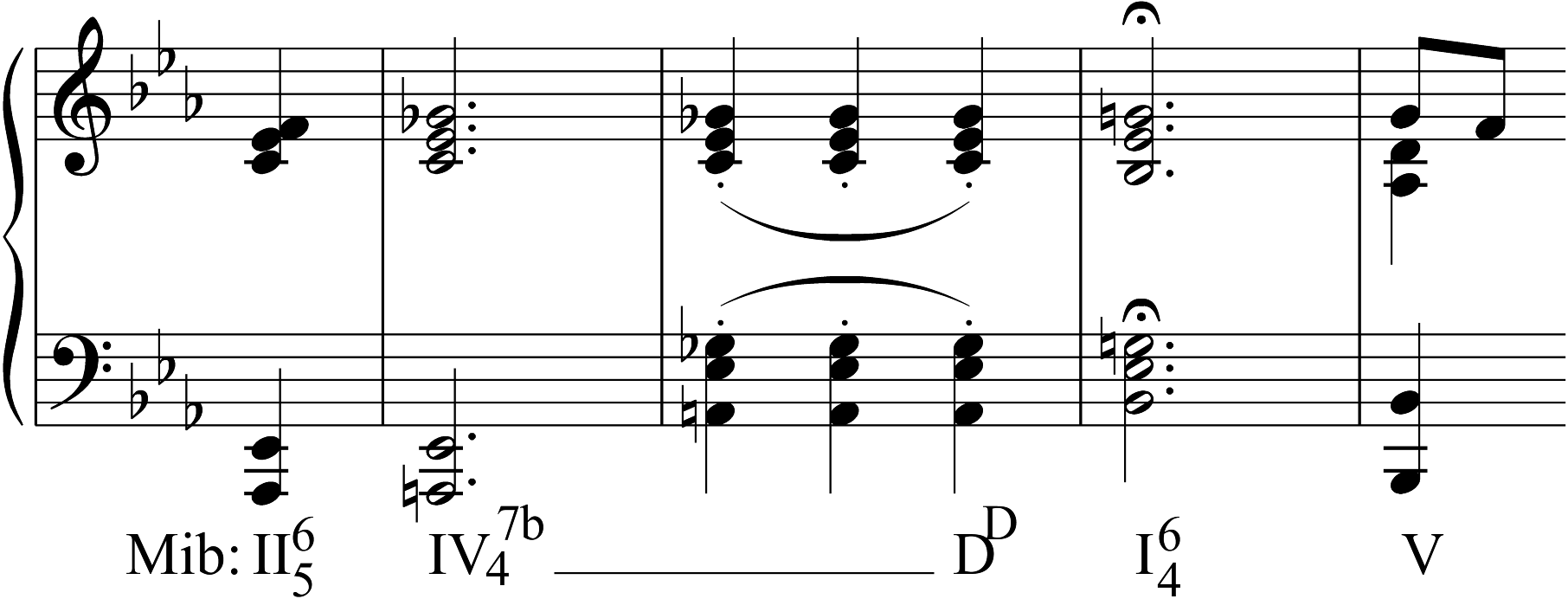 ,
,
then the structure of the chord involves G flat, conditioned by all the vertical components (especially those of the natural note).
At the beginning of the treatment, however, when the direction is towards C minor, the chord contains F sharp (which cannot be mistaken for G flat) precisely via the condition of the resolution (on the fifth of the tonic):

In the context of the chromatic densities of the last Romantics, the phenomenon of the appreciation of an harmonic alteration becomes, however, a difficult issue, even in analysis, to say nothing of the difficulties involved by an auditory appreciation. As we pointed out earlier, even some composers transcribed enharmonically certain chromatic notes or chords for a better visualization. In the following example:
Liszt: Concerto No. 1, I

Liszt replaces the Neapolitan sixth chord F flat-A flat-C flat with his enharmonic E-G sharp-B, in order for it to be more easily read on the keys of the piano.
3. The alterations with a melodic role (especially the passing ones) in principle follow the sense of the direction of the melodic profile, but not always very thoroughly.
Here is an example in which Beethoven uses descending alterations for an ascending movement: Beethoven, Sonata Op. 2, No. 1, II
 , or, in relation to the melodic role, he changes the alteration:
Beethoven, Sonata Op. 2, No. 2, Rondo

phenomenon which is difficult to notice if only the melody is heard.
Slight spelling variations (of the melodic alterations) also occur from one composer to another, especially in the case of the Romantic composers.
Correct chromatic spelling within the tonal-functional system during the dictation classes, to the extent possible through audition, therefore consist in the stylistic skills, in the stylistic education, through which an algorithm is formed, which is built, though, on the basis of an understanding of the chromaticism phenomenon within this tonal-functional system.
Modulation
The tonal-functional system also establishes the modulation phenomenon, that is, the process of passing from one tonality to another.
The embryo of the idea of modulation has always existed in music. Thus, in oligochordic music, certain mutations of the micromodal units indicated this intention of variation in the melodic movement. In pentatonic music, C. Brăiloiu introduces the notion of metabole, meaning a mutation of the center of the pentatonality onto other sounds. The folkloric modal systems also display, within a melody, coupling possibilities for several different modal units. In the vocal polyphonic creation of the Renaissance, there were revealed those permanent cadences on different steps of the mode, as well as the procedure of infiltration, all of these leading to what Jeppesen called "incursions into the realm of other modes," and other authors (Eisikovits) call "modal modulation.
The creation in the tonal-functional system will, however, assign a colossal role to modulation, the role of interior reactive dynamics of any musical work. From the most simple evolution within a small form (bi-tripartite lied), where the implication of a modulation meant the sine qua non condition, to the modulatory thematic relations from certain large forms (fugue, sonata, rondo-sonata, etc.), all the way to the establishment of the giant arcs of the treatments in these extensive forms, based on a maximum density modulatory crucible - this is, briefly, the role of modulation from the perspective of so many masterpieces created by Baroque, classical and Romantic composers.
As a technical process regarding the means of passing from a tonality to another, modulation is of three types: 1. diatonic, 2. chromatic, 3. enharmonic.
Through the medium of these three forms, the following may be realized:
- a modulation proper, which means the process of passing from one tonality to another, marked by a cadence in the new tonality, or the triggering of a new musical idea (in the new tonality):
- a modulatory inflection (passage modulation), when the process of advancing in the new tonality is not confirmed by the cadence (or by a new musical idea) and the return to the initial tonality occurs.
1. The diatonic modulation is the modulation that is realized via a common chord (common steps). Consequently, the diatonic modulation is accomplished between neighboring tonalities in the scale of the fifths and those that find themselves in a relation of relatives, also called kindred tonalities.
The diatonic modulation via first degree kinship (relation of one fifth and relatives) is done:
- from major – to the dominant, subdominant, the relative of the dominant and the relative of the; (C major-G major, F major, A, E, D)
- from minor – to the dominant, subdominant, the major parallel, the minor parallel of the dominant and subdominant (A minor – E minor, D minor, C major, G major, F major).
The diatonic modulation through second degree kinship (relation of two fifths) is done:
- from major – to the dominant of the dominant and its relative, to the subdominant of the subdominant and its relative (C major – D major, B minor; B flat major, G minor);
- from major – same as above (A minor – B minor, D major; G minor, B flat major).
The diatonic modulation in the case of distant tonalities is done through:
- modal inversion (C major – c minor; A minor – A major);
- the minor subdominant;
- successive harmonic relations.
2. The chromatic modulation is realized through the alteration of the diatonic chords. By chromatically modifying one or more sounds from a diatonic chord, the latter changes its function as compared to the function it had in its natural state. This new function consequently engages a modulatory evolution:

(N.B. By altering the third of the chord of step I in A minor, the chord automatically changes its function in step I in A minor in step V (D) from D major and thus the modulation is produced.)
Any sound that’s part of a major, minor, diminished, augmented, or seventh chord may suffer chromatic modifications.
The alterations of a major chord:
- the descending alteration of the third:
 bestows on it the function of S or D:

- the ascending alteration of the fundamental:
 bestows on it the function of D or DD;
- the ascending alteration of the fifth:
 bestows on it the function of D or DD in formulas with an augmented sixth:

- the descending alteration of the third and fifth:
 confers on it an S and D function:

- the ascending alteration of the fundamental, of the third, and of the fifth confers on it a D function:

- the descending alteration of the fundamental, of the third, and of the fifth confers on it an SN function:

- divergent alterations: the third - descending, the fundamental – ascending, confer on it a D or DD function:
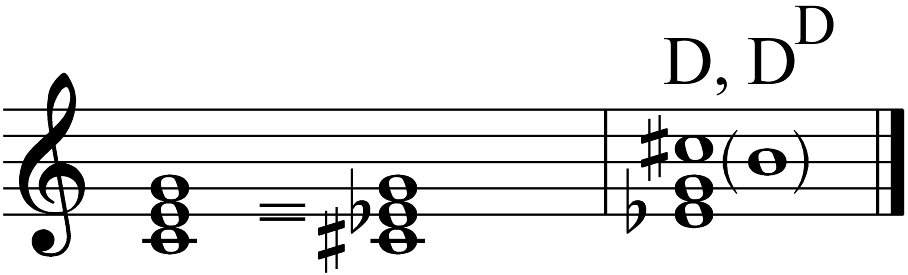
The alterations of a minor chord:
- the ascending alteration of the third confers on it a function of D or DD:

- the descending alteration of the fifth confers on it a D or DD function:

- the ascending alteration of the fundamental confers on it a DD function in formulas with an augmented sixth, of D and S:

- the descending alteration of the fundamental confers on it a DD function:

- the ascending alteration of the fundamental and of the third confer on it a D or DD function:

- divergent alterations: the third – ascending, the fifth – descending, confer on it a DD function:

The alterations of a diminished chord:
- the alterations by which the diminished chord transforms into a major (the descending alteration of the fundamental) or minor chord (the ascending alteration of the fifth):
 offer the possibility to interpret these chords in diverse functions (as principal or secondary steps);
- the double alterations (the descending alteration of the fundamental and of the third, the ascending alteration of the third and of the fifth) offer the same situation:

The alterations of the augmented chord:
The alterations of the augmented chord generally lead to the obtaining of certain forms of chords similar to the ones obtained from the major or minor chord. However, because there is only one augmented chord in a natural state (step III in the harmonic and melodic minor), it is only very rarely that the occasion to alter it arises.
The alterations of the seventh chord of D (i.e. dominant) (major with a minor seventh):
- the ascending alteration of the fundamental confers on it a D or DD function:
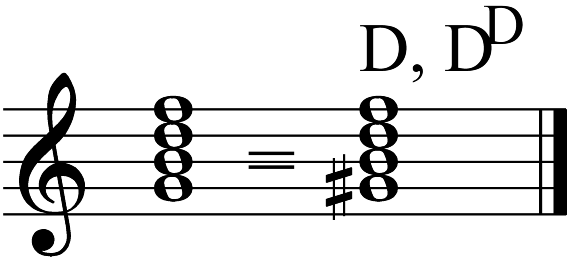
- the descending alteration of the third confers on it a function of S or D:

- the ascending alteration of the fifth confers on it a D or DD function via the structures with an augmented sixth:

- the descending double alterations (third-fifth, fundamental, a), the divergent ones (fifth descending – fundamental ascending; fundamental ascending – third descending, b), the triple alterations (parallel or divergent, c):

offer further functional-chromatic interpretation possibilities (usually D, DD, and S) of the initial seventh chord of D (i.e. dominant).
The alterations of the minor chord with a minor seventh:
- the ascending alteration of the third bestows on it a D and DD function:

- the ascending alteration of the fundamental confers on it a DD function (with an augmented sixth):

- the descending alteration of the fifth confers on it a an S and D function:

- the descending double alteration (fifth and seventh)
- and the descending double alteration (fundamental and third,
- transform it into a chord with a diminished seventh, acknowledged for its D or DD function:

The alterations of the chord of a diminished seventh:
- the descending alteration of the fundamental bestows on it a D function:

- the descending alteration of the third bestows on it a D and DD function (structures with an augmented sixth):

- the descending alteration of the fifth confers on it a D and DD function (structure with an augmented sixth):

- the ascending alteration of the seventh confers on it an S function:

- the parallel double alterations (ascending or descending), the divergent ones, or the triple ones, offer chordal forms (sometimes capable of having another origin as well) which, in general, are aligned to the function of D and DD:

In principle, all of the other species of chords with a seventh encountered in a natural state in the tonality may be altered (in a simple, double, triple, and divergent manner), as a result of which chords with modulatory possibilities are obtained.
In all situations, by the consistent repetition of the chromatic modulation via an altered chord, the following chromatic modulatory sequence can be obtained:

The exposition of the chord alteration possibilities completed above (without claiming to be comprehensive) proves the huge flexibility of the system of tonalities and their multiple circumstances.
The chromatic modulation thus represents the richest form, with the widest possibilities for maneuvering, as it is in fact illustrated in the works of all classical and romantic masters.
The center of attention of a chromatic modulation is the altered chord and the interpretation of its function. In this sense, the realization that, via alterations, leading notes (ascending or descending) are most often created, and it implicitly follows that these, implying the resolution, fall into the category of a dominant-type chord form (D or DD), it can be asserted that chromatic modulation in fact means the modulation through the creation of dominants. The chain of such a process may lead to continuous dominantization, which is exactly what will happen in the works of the late Romantics and post-Romantics.
3. Enharmonic modulation means the change of the spelling of a chord, and, at the same time, the reinterpretation of its function (according to the procedures of diatonic or chromatic modulation).
Enharmonic modulation is mainly based on three chords:
- the diminished seventh chord;
- the augmented chord;
- the chord of the seventh of D, which, by enharmony, becomes an augmented fifth-sixth chord.
The enharmony of the chord of a diminished seventh:
It is a chord with a symmetrical structure (3 minor thirds, 2 intercalated diminished fifths), and it has a totally remarkable trait, in that it changes its identity via enharmony. Thus, taking the diminished seventh chord in A minor, it displays four possibilities of enharmonic change, in which each of its sounds can be considered a leading note (for this purpose, the third sound may be also changed enharmonically, and the fourth needs to be changed direct):
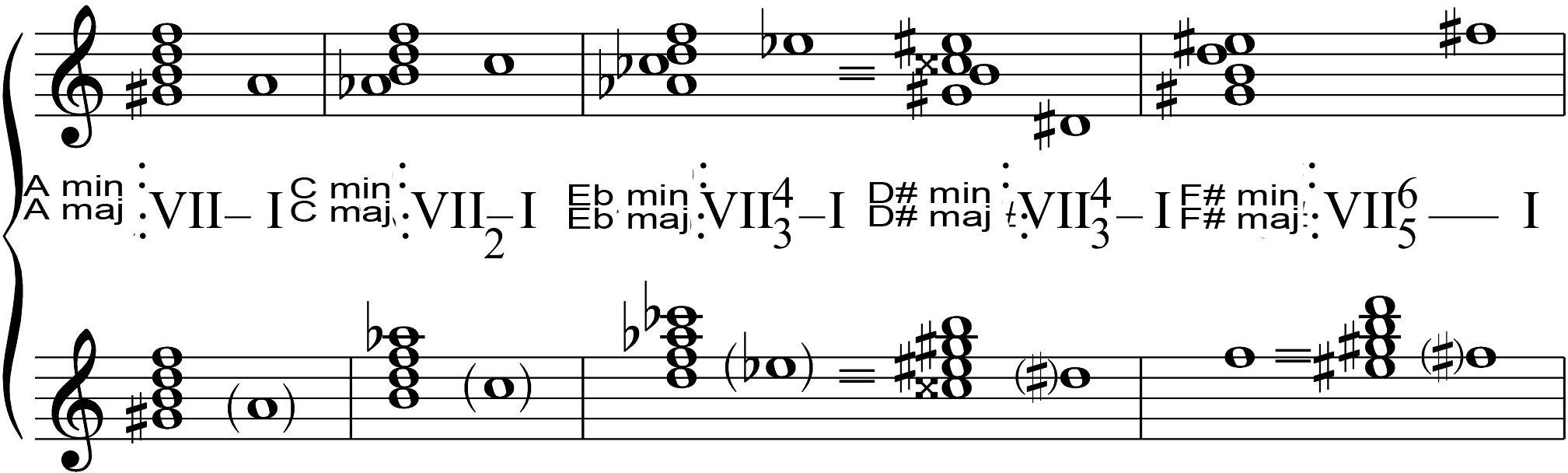
As one can see, its function is always a D function (i.e. dominant), but it can just a easily be a DD function.
Thus, a single chord holds the possibility of modulation among five tonalities (four, in fact, if one bears in mind the enharmony of two of them). Hence the conclusion that there are two more diminished chords by which the remaining 10 tonalities (up to tonality 15) are covered. These two chords may be considered the chord in D minor (one flat key signature) and the one in E minor (one sharp key signature):

But the same diminished chords can, at the same time, also be used for the modulation in the major tonalities. Consequently, the enharmonic modulation in all the 30 major and minor tonalities may be encompassed with the three diminished chords.
Enharmonic modulation via the diminished seventh chord came first historically: it occurred in the Baroque (Bach) and in classicism:
Beethoven: Sonata Op. 13, I

The enharmony of the augmented chord:
The structure of two major thirds confers on the augmented chord possibilities of enharmonic interpretation through the equivalence between the major third and the diminished fourth:

Similarly, there are three further augmented chords, each having three possibilities of enharmonic change, by which all of the major and minor tonalities are covered:

Liszt provides a brilliant model of enharmonic modulation in "Il Penseroso" by using the augmented chord:

The enharmony between the seventh chord of the dominant and the augmented fifth-sixthchord:
The enharmonic equality of the minor seventh to the augmented sixth allows the enharmonic change between the two chords:
Beethoven, Symphony No. 3, p. IV

Other transformations are also possible, through the enharmony of the fifth with the doubly-augmented fourth, or of the fundamental and third with the enharmonic equivalents in descending alteration:

In addition to the chords presented above, used by enharmonic modulation, there are other chords as well that lend themselves to enharmonic interpretations (for instance, the minor chord with a minor seventh, the diminished chord with a minor seventh, the augmented seventh chord in second inversion) and, also, chords that, at the same time as certain enharmonic exchanges from within themselves, are also associated with other chromatic alterations.
In this manner, the enharmonic modulation possibilities become complex and unlimited, as they are perceived in the post-Romantic language (for instance, in the work of R. Strauss).
The exposition of the modulation possibilities cannot be concluded without mentioning the phenomenon of the third relations. They occur in the shape of:
- loan of chords between the relative tonalities (C major – A minor);
- loan of chords between the homonymous tonalities (C major – C minor);
- the extension of the (minor, major) third relations to between the tonalities that are not in a relation of relatives or homonyms (C major – E major, E minor; C major – E-flat major, E-flat minor; C major – A major; C major – A-flat major, A-flat minor).
In the first two cases, the evolution tends towards the unification of the major with the minor and the obtaining of a broadened tonality.
In the third case, by forcing (broadening) certain relations that the initial tonality law did not mention, a new principle is introduced – the distance principle.
Of course, all modulations within the third relations use one of the diatonic or chromatic procedures presented before, but the phenomenon of the third relations (which occurred as early as Gesualdo in certain chordal successions) represents yet another logic of the connections of tonalities.
The study of modulation also requires a transparency of its evolution from the point of view of the procedures, but especially from the point of view of the relations among tonalities.
Thus, the Baroque is acquainted with diatonic and chromatic modulation, but is a stranger to enharmonic modulation. At the same time, while diatonic modulation is a good that totally belongs to the Baroque, chromatic modulation uses only some forms of alteration: the simple ascending and descending alterations in the major and minor chords, the descending double alterations of the major chord, alterations with the purpose of obtaining a diminished seventh chord – represent the totality of procedures for the realization of chromatic modulation in the Baroque.
By both the diatonic and the chromatic means, the Baroque modulations do not exceed certain distances in the circle of fifths.
Thus, within a work in a major tonality, the modulations are achieved:
- frequently, in the case of D (i.e. Dominant), in the case of the minor relative, in the case of the relative of the S (i.e. Subdominant), in the case of the D of the relative (or the relative of the D), in the case of S;
- less frequently, in the case of the minor d (i.e. dominant), the major parallel to the minor d (i.e. dominant), in the case of DD and its relative. For instance, supposing a work is in the C major tonality, the following relations follow: C major – G major, A minor, D minor, E minor, F major, G minor, B-flat major, B minor, D major.
In a work in a minor tonality, the modulations are usually achieved:
- frequently, in the case of D, the major parallel, in the case of S, in the case of the D of the parallel (or the parallel of D – i.e. of the Dominant), in the case of the parallel of the relative of the S;
- less frequently, in the case of the minor relative of the S and the minor relative of the D.
Taking as an example the A minor tonality, the modulations can be achieved in the case of: E minor, C major, D minor, G major, F major, B minor, G minor.
Of course, the most advanced stage, both in terms of chromatic modulation procedures as well as relations (distances) between tonalities is revealed by J.S. Bach’s works. The next stage, classicism, advances, especially through Mozart and Beethoven, towards the broadening of the chromatic modulation possibilities, also initiating the enharmonic modulation. In terms of the modulatory relations between tonalities, classicism develops especially the principle of the third relations (C major – E major, C major – E-flat major, C major – E minor, C major – E-flat minor, C major – A major, C major – A-flat major, C major – A minor, C major – A-flat minor), opening the road for the distant modulations, so that an inventory of these modulations is no longer useful.
In Romanticism and Post-Romanticism, the (diatonic, chromatic, and enharmonic) modulation phenomenon is the very raison d’être of the musical discourse. The surprise modulations (accomplished with a certain abruptness) between distant tonalities represents the very savor of the harmonic language. But Romanticism is the most expansive stage not only in terms of modulatory possibilities, but also in terms of the diversity of the modulations, of the restricted space in which a modulation or a succession of modulations are accomplished. If the Baroque and classicism conceived modulation as being divided into long sections (phrase, period, etc.), the Romantics, and especially Liszt, Berlioz, Brahms, or the Post-Romantics R. Strauss, Franck, Mahler, promote modulation from chord to chord. The continuous, "floating" modulation has already been mentioned, always evolving towards a new tonic which, like a "Fata Morgana," is difficult to reach and hardly ever materializes. The notion of modulation itself now seems to have changed its definition, rather reverting the meaning to inflection. That is why between the large areas, for instance between theme I and II of a Romantic sonata, a relation between two tonalities is kept (T-D, T-mediant, etc.), but within each area, the chromatic process of the chords produces a continuous floating, so that the supposed tonality is permanently imponderable, being made up of a mosaic of inflections.
Consequently, during Romanticism (and Post-Romanticism), modulation reaches its highest level, exploiting all the nooks of the tonal-functional system.
A survey of the modulation possibilities of the tonal-functional system reveals the fact that the modulation phenomenon (involving the alterations and the chromaticisms) represents the essential dynamics of functionalism – in fact, the very zest of the Baroque, classical, and Romantic work of art.
At the same time, the alterations and chromaticisms (generated according to the leading note principle) engaged by the modulation in a continuous evolutionary process from the Baroque to Romanticism, exhausts the resources of the tonal-functional system, thus bringing its historical-artistic role to an end.
The expressivity of tonalities
The issue of the expressivity of tonalities, sometimes also called the "color" of the tonalities, often appears, in the subtext of many musicological commentaries, as being involved in the analysis of a work belonging to the tonal-functional system, but it always remains within the sphere of the ineffable.
In connection with this issue, music theory has provided so far especially anecdotal, rather than actual, documents. That is why, the issue requires the necessity of a study that only computerized technology is able to accomplish. However, at this point it is impossible to appreciate the advantages of employing such a study.
However, based on certain observations on the musical creation in the three creative eras, certain conclusions may be drawn concerning the situation of the approach adopted towards the tonalities by each stylistic stage.
This historical criterion, however, does not reveal that the tonalities and the modulatory relations among them are favored according to a certain expression or color of theirs, but they are favored rather according to the technical possibilities offered by the instruments of each era.
Consequently, from this point of view, only the issue of the use of tonalities can be brought into discussion, in a comparative manner, from one era to another.
From this point of view, incipient Baroque (Monteverdi) will use the tonalities that occur out of the totalization of the six major and minor polyphonic modes (C major, G major, F major, A minor, D minor, E minor), plus the tonalities derived from the modes transposed in molle fashion (B-flat major, G minor) and the reverse extension in naturale fashion (D major, B minor).
The middle Baroque (Corelli, A. and D. Scarlatti, Vivaldi, Couperin, Rameau, Purcell, Buxtehude, etc.) does not succeed to extend by much the circle of tonalities, due to the technical limitations of the instruments of that time. Consequently, they will approach the tonalities up to 3-4 alterations to the key signature. Only in the domain of the harpsichord, perfected as a result of the discovery of temperament (1691), tonalities with 5-6 alterations are also used (sporadically), as is the case with D. Scarlatti’s sonatas.
At the peak of the Baroque, Bach comes up with the idea to compose in all the tonalities up to 7 alterations, which is exactly what he does in his work "Das Wohltemperierte Klavier" ("The Well-Tempered Piano"). It must be pointed out, though, that if in the two volumes (the first – 1722, the second – 1744) Bach uses the tonalities with 5-6-7 alterations, in no other orchestral or vocal-orchestral work will he approach tonalities with more than 4 alterations due to the same limitations of the instruments, especially those of the wind instruments (wood, brass).
Classicism remains at the "well-behaved" level of the last Baroque representaives, and it is only occasionally that tonalities with 5-6 alterations are used (Beethoven, Piano Sonata Op. 78).
But the progress of the manufacture and multiplication of instruments is permanent, too. In the case where the instrument by its construction cannot offer the chromatic scale, series of instruments are adopted, according to tonality (for instance, horns in C, D, E, Es, F, B, etc., trumpets in F, B, A, etc.). Thus, the Romantics already manage to have at their disposal an orchestral apparatus having the possibility to approach all tonalities. If one also takes into consideration Romantic (and Post-Romantic) modulation stage, a paradox is reached, and namely, that at a certain point in time the tonality in which a certain work is approached no longer matters, the continuous modulation using any tonal development. That is why "Tristan and Isolde" by Wagner opens in A minor. Similarly, the 20th century composers who will continue to use the tonal-functional system, often give up conceiving the work in a certain tonality, and write without a key signature.
The tonal-functional system is the system that unified the creation of three great musical styles – the Baroque, classicism, and Romanticism, over a period of about 300 years.
The internal resources of this system (associated with the force of instrumentalism) offered the possibility for some creations to emerge on an unprecedented scale, such as Bach’s "Passions," Händel’s oratorios, the symphonies of Haydn, Mozart, Beethoven, Brahms, Berlioz, and the operas of Gluck, Rossini, Verdi, Wagner.
However, the tonal-functional system exhausts its resources in the creation of the last Romantics. At the same time as these there already emerge intentions to open up this system, by combining it with certain modal intuitions (Mussorgsky, Debussy).
At the beginning of the 20th century, the tonal-functional system, however, suffers a brutal and declared repudiation by A. Schönberg’s initiative to elaborate a new tonal system … atonalism. At this point, the tonal-functional system exits the scene of creation with the entire cortege of phenomena (harmony, form, rhythm-meter, etc.) that used to belong to it, being replaced not only by atonalism, but also by other systems.
The tonal-functional system, through its internal connections based on attraction, emerges in the musical thought at he same time as the metaphysical stage in philosophy, marked by the conception of the monads with "pre-established harmony" established by the supreme monad, conception developed by Leibniz, and at the same time as the new conception in physics, where the law of universal gravity is formulated by Newton. Its evolution is then parallel – and corresponds – to the new achievements of philosophy: Kant’s antinomy theory and Hegel’s dialectics. The demise of its creative-esthetic role as a result of the emergence of certain new tonal-modal conceptions coincides with the emergence of Husserl’s phenomenology and with the new cosmogonic outlook of Einstein’s theory of relativity.