Neoclassicism
From DIMA
Author : Gabriel Banciu
|
A tendency to reinstate in composition of some composition techniques from classical or pre-classical music, as a reaction to the excessive chromatism of post-Wagnerians, the shaded contours of the Impressionists and the hard dissonances of the Expressionists. A first use of the classic language was achieved in Romantism by J. Brahms. But if with the German composer the symmetry and formal balance are related to his personal style, Busoni and Reger cultivated a Neoclassicism embedded in the hyper-chromatic harmony of late Romantism.
The evocation of the genres and forms of the Baroque represent a first attraction for the 20th century composers: Stravinsky (Concertino for String Instruments, Concert for Wind Instruments, opera-oratorio Oedipus Rex, Symphony of Psalms), Honegger (oratorio Le roi David, Partita for 2 pianos, Monopartita and Archaic Suite for Orchestra), Hindemith (Kammermusik op. 36, music for piano, harph and Woodwind Instruments), Bartók (Concerto for Orchestra), Martin, (Concerto grosso, Double Concert for 2 String Orchestras), Shostakovich (24 Preludes and Fugues for Piano).
Influences of the genres and forms of the Vienese Classicism (the sonata-symphonic cycle; the opera): Stravinsky (Symphony in C, the opera The Rake’s Progress), Ravel (Concert for piano and orchestra in G), Prokofiev (Classical Symphony).
The Renaissance, with the specifically polyphonic writing and the madrigal genre, or even the Gregorian: Rachmaninov, Hindemith (Dies Irae), Orff (Carmina burana), Respighi (Gregorian Concert for violin and orchestra, Mixolydian concert for piano and orchestra) and others (enek, Kodály, PendereckicK).
The evocation of a country’s ethos, culture, the homage brought to the forerunners: Ravel (Sonatina for piano, Piano suite Le tombeau de Couperin), Debussy (Hommage a Rameau).
The Romanian composers used the suite, divertimento and orchestral concert genres: Enescu (Suite in antique style for piano op. 3, Suite for piano op. 10, Sonata for piano nr. 3, Suita I for orchestra), Lazăr, Lipatti, Negrea, Silvestri, Toduţă, and Paul Constantinescu, in the oratorio genre (Byzantine Christmas Oratorio and Byzantine Easter Oratorio).
Concerto for String Orchestra (no.1) by Sigismund Toduţă
An identification of the genres covered by the works of Sigismund Toduţă is illustrative in order to prove its area: from vocal, choral, vocal-symphonic and theatrical works, up to the symphonic and chamber areas. Nevertheless, one of the most widely spread genres of the time, the string quartet, seems not to represent the thinking of the composer from Cluj. The homage volume, dedicated to his 70th anniversary, does not include, among the musical works (from 1933 until 1978) any composition of this type. More recent research specify the existence of a Quatuor in d minor, dated 1933-1935, the same time period he wrote the more famous symphonic work, the Eclogue. The genre is not to be found again among Toduţă’s works and in order to find a plausible answer to motivate this absence, certain explanations are required.
The fact that Toduţă studied in 1936-1938, at the Santa Cecilia Academy in Rome with Ildebrando Pizzetti (1880-1968) - composition and Alfredo Casella (1883 1947) – piano is well known. Twelve years before he began his studies in Rome, Gabriel Fauré composed The String Quartet in E Minor, op. 121 (1924), the final work of the former professor of composition at the Conservatory in Paris, having George Enescu (from 1895 until 1899) and Alfredo Casella (in 1896 or 1901) as his disciples.
The genre of the string quartet came from a great tradition, not only during Classicism and Romanticism, but also in the beginning of the 20th century. The example given by The String Quartet in G Minor, op. 10 (1893) by Debussy was to be followed in the first half of the past century by: Ravel – The Quartet in F Major (1903), Schönberg – Quartets no. 1 (1905) and no. 2 (1907), Pizzetti – The Quartet in A Major (1906), Bartók - Quartets no. 1, op. 7 (1908) and no. 2 (1915 17), Webern – Five Movements for String Quartet op. 5 (1909), Berg (1910), Stravinsky – Three Pieces for String Quartet (1914), Casella – Five Pieces (Cinque pezzi) for String Quartet (1920), Enescu Op. 22 no. 1 (1920).
The work of Fauré was followed by Respighi – The Dorian Quartet (1924), Berg – The Lyrical Suite (for string quartet - 1926), Bartók - Quartet no. 3 (1927), d’Indy - Quartet no. 2 (1927), Schönberg - Quartet no. 3 (1927), d’Indy - Quartet no. 4 (1930), Prokofiev - Quartet no. 1 (1930), Pizzetti - Quartet no. 2 in D Major (1933), Schönberg - Quartet no. 4 (1937), Webern - Quartet op. 28 (1938), Bartók - Quartet no. 6 (1939), Prokofiev - Quartet no. 2 (1941), Milhaud – The String Quartet no. 12, “in memory of Fauré” (1945) and Enescu - Op. 22 no. 2 (1951).
In the list of Casella’s works we find, besides the Five Pieces, another genre (mixed: chamber-concerto), ignored by dictionaries of musical genres, that is Concerto for String Quartet (op. 40). It was not a novel idea, as four years before Stravinsky had composed a Concertino for String Quartet (1920). The orchestra transforms itself, in order to reach timbral purity, into a quartet, the same way the orchestras of the future decades will have to play pieces “for solo instruments” (Stravinsky - Concertino for 12 Instruments, 1952, Enescu – Chamber Symphony for 12 Solo Instruments, 1954).
The other way around, the old chamber ensemble was the creation laboratory for future orchestral arrangements. Thus, in 1917, Schönberg transcribed the Quartet no. 2 (composed in 1907) for string orchestra and the string sextet Verklärte Nacht (composed in 1899) had the same faith.
In Romanian music, the Concerto for String Quartet (1947) by Paul Constantinescu became (in the composer’s transcription) Concerto for String Orchestra (1955).
We can therefore consider the concerto for string orchestra a continuation, in a hyperbolic sense, of the chamber way of thinking. Nevertheless, Casella also composed, in 1927, a Concerto for String Orchestra, genre also to be found among the works of Bartók (Divertimento for String Orchestra - 1939) and Stravinsky (1946).
The neobaroque connotation of the string concerto genre (modern replica of the concerto grosso) is certified by works like: Concerto for String Quartet and Orchestra by Bohuslav Martinú (1931), Concerto for String Quartet and Orchestra by Virgilio Mortari (1937), Concerto for Double String Orchestra by Michael Tippet (1939) as well as concertos for string orchestra signed by less famous names: Wolfgang Fortner (1932), Karl Schiske (1941), Boris Blacher (1942), Bernd-Alois Zimmermann (1947), Alan Rawsthorne (1948), Johann Nepomuk David (1949 and 1950), Grazyna Bacewicz (1950).
In the context of the neoclassical meanings of the genre, Sigismund Toduţă composes, in 30 years’ time, four concertos for string orchestra. The first one, dated 1952, the second one (in 4 parts: Prelude, Fugue, Recitative and Arioso, Toccata) and the third one, “in stile antico” (in 3 parts: Ostinato - 26 variations and Coda, Aria, Dance - fugue) were composed in successive years (1972-73, 1973-74 respectively). The last concerto, the fourth one (1980 81), adds the organ to the string orchestra, maybe as an homage to Alfredo Casella, who had used, in Concerto Romano (1925), organ, 3 trumpets, 3 trombones, strings and percussion.
Toduţă’s string concertos had Casella’s works, Concerto for String Quartet (1924) and Concerto for String Orchestra (1927) as a direct model.
The first of them (transcribed for string orchestra ) has 4 parts, with the movements: I. Sinfonia, II. Siciliana, III. Minuetto, Recitativo, Aria, IV. Canzone.
The first part, Allegro brioso e deciso, declares its introductive role to a work evoking the old orchestral suite.
The theme, began isorhythmically (beats 2-4), realizes the contrast between the horizontal, diatonic dimension of the discourse (violino 1) and the harmonic dissonant one:

The construction of the Sinfonia reminds of the form of the Baroque concerto, with a thematic succession A - B - A - C - A - coda. The neoclassical structure hides a neomodal language, with many moments of imitative polyphony. In the following example, the interval of the imitation (E - eb - d1 - c#2) is to be noticed:

The theme with the Sicilian rhythm of the second part

reveals the same pole-anti pole opposition, given by the augmented fourth (both horizontally and vertically) in the first movement.
The last two parts, based on the same Baroque constructions (Minuetto, Recitativo, Aria, Canzone) indicating alternation of the syncretic elements (dance, vocality, but also the instrumental alternative), end, in cyclic spirit, with the remembrance of the first movement theme (Tempo della “Sinfonia”).
Concerto (no. 1) for String Orchestra by Sigismund Toduţă structures all its three parts starting from the initial theme, intonated together. The themes of parts II and III are metamorphoses of the initial thematic material:


In the score (printed by Editura de Stat pentru Literatură şi Artă in 1956), the following notes can be found (of course, with the accept of the Maestro): “This concerto [...] is proof of the author’s inclination towards folklore. The folkloric melody, so clear, chosen as a basic theme of the composition [...] has the modal characteristics of the Romanian song. Nevertheless, the modal traits of the folkloric melody are highlighted in all three parts of the concerto, by a very original harmonic and polyphonic approach. The first part (Allegro moderato) is based on the theme of the folk song in the introduction. It is interesting to note the construction of this part, evoking the style of ‘concerto grosso’, characteristic to 18th century orchestral writing. The orchestral plan (tutti) and the group of soloists (piccolo concerto) progress in dialogue, developing the main subject. In the second part (Andante molto), the main melody of the first movement comes back as a lullaby, being then developed in a ternary, complex form. The finale (Allegro giocoso), conceived as a monothematic rondo, is also based on the introductory song, this time dressed as a joyful dance.”
The metaphoric value of thematic significance gives the work aesthetic cohesion. Themes are differentiated at the level of duration (semiquavers, crotchets, quavers) and of measure, with elements of melodic variation, but especially at that of character. The folkloric intonation of the initial theme changes therefore into a lullaby and then into a discourse with dancing, playful touches.
It is interesting to notice the transversal confrontation of themes also from the point of view of melodic directions.
The first part brings a construction of morphologic symmetries (ascending-descending),
the second part brings an ascending vector,
while the descending direction belongs to the finale:
Hegel’s triad appears reversed here.
With regards to the metric of the themes, a hermeneutical impulse allows us to ascertain a correspondence between the measure and the range of the themes.
The measures of the themes are: three alternating with two crotchets, for the first part, two crotchets for the second and the alternation five quavers with three quavers for the finale (that is: 3/2 - 2 - 5/3 beats).
The numbers presented, expressed as frequency reports, represent the intervals of Pythagorean fifth or perfect natural fifth (3/2) , perfect octave (2, or 2/1) and the major sixth (5/3).
The theme of the first part is structured in the range of two perfect fifths (3/2) descending, juxtaposed, according to the metric alternation of 3 and 2 beats:

If we consider e2 as cambiata, then the second theme also fits the range of a perfect octave (2/1), corresponding to the binary meter:

Finally, the beginning of the third part theme corresponds to the range of major sixth (5/3), in accordance with the metric alternation of 5 and 3 quavers:

The numerological evidences become interesting only as (Pythagorean?) elements of internal cohesion of the work, without being suspected, in any way, of premeditation.
The first part of the Concerto no. 1 for String Orchestra by Toduţă is structured tri-strophically, the character of the initial theme being close to the intonations of the doina, with the indication Molto rubato, con gaio. The medial strophe, an Allegro moderato, is a modern replica of the concerto grosso. The orchestra is divided into Soli (two violins and two violas) and Ripieni (violin I, violin II, viola, cello and double bass) and the theme, the folk melody in the beginning (a varied A) gains preclassical intonations (with new metaphoric meanings):

the entire medial strophe is based on the alternation between Ripieni and Soli, typical for the Baroque concerto. Here, imitative polyphony receives rigorous aspects, of canon, in octave,

also used for the finale of the work,

or in descending fifth:

In neobaroque spirit, the hemiola is also present:

The reprise brings back, in tutti, the initial intonation of the theme (Tempo 10, molto rubato)
The second part, Andante molto, is also structured tri-strophically, the middle being characterized by polyphonic imitative procedures (fugatto):

The finale (Allegro giocoso) is a monothematic rondo. In the second couplet (C) we find augmentation (from an aesthetic point of view - hyperbola):

Sfârşitul aceluiaşi segment valorifică virtuţile expresive ale pauzei, într-o manieră neo beethoveniană:

The ending of that same segment uses the expressive virtues of the fermata, in neo-beethovenian manner:
The finale of the rondo brings the incipit of the theme in vivacissimo.
The short analysis of the first string concerto allows for the expression of a few short conclusions:
- - the concertos for string orchestra are, in Toduţă’s works, the synthesis genre, uniting the chamber and the symphonic areas;
- - Sigismund Toduţă is, as such, one of the great composers of the 20th century, excelling in works belonging to this genre, together with Bartók and Stravinsky;
- - the blend of folk elements (thematic material, modal cadences, the rubato) with the neoclassical aspect of creation (preclassical forms, polyphonic language) is typical;
- - in relation with his professors at the Santa Cecilia Academy, we consider that the disciple has surpassed his masters;
- - the fact that the genre is also present in the works of Paul Constantinescu, his great contemporary, is notable.
Therefore, although we agree with the words of a distinguished colleague: “It is an act of great courage to write a string quartet in the second half of the 20th century” , we consider the concerto for string orchestra to be an amplification of the chamber genre, corresponding to the expressivity of Toduţă’s musical language.
Toduţă’s Rhetoric in Concerto for String Orchestra No. 2
In 1973 Sigismund Toduţă received the Composers’ Union Award for the first volume of Formele muzicale ale barocului (The Musical Forms of the Baroque) and wrote, together with Hans Peter Türk, the second volume. The theoretical approach of rhetoric thinking seems to have a natural compositional response in the second Concerto for String Orchestra, with its movements (Preludio, Fuga, Recitativo e arioso and Toccata) reviving, in a neoclassical spirit, the genres of the 17th and 18th centuries. The fact that the second part is the Fuga (Fugue), according to the typology of the old sonata da chiesa and of Bach’s sonatas is not accidental. The succession of parts leads us to other conclusions also: the Prelude and the Toccata, both with an improvisational character, seem to create a certain symmetry; within the boundaries of this symmetry the “instrumental” and the “vocal” confront each other, that is, the real aspect of the perfection of instrumental polyphony and the ideal aspect represented by the “vocality” of the instruments.
The analysis of this modern representation of the concerto grosso determined us to begin by expressing the conclusions. We therefore ascertain that the work synthesizes the elements of Toduţă’s language, becoming thus a possible reference point in the maestro’s creation, due to:
- - the ethos generated by the use of diatonic and chromatic modal structures;
- - the melodic based on gradual progress or on the sometimes symmetrical alternation of seconds and thirds (the theme of the first part);
- - the use of appoggiaturas and the quasi-improvisational character of the discourse;
- - the use of the ostinato;
- - the predominance of chromatic progress (the theme and counter-subject of the fugue) and melodic turns based on inverted chromaticism;
- - melodic closures (resembling the conclusive monodic formula clausula) finalized by descending leap of third or fourth;
- - thematic anticipations belonging to cyclic thinking (the theme and the counter-subject of the fugue, present in the first part);
- - the configuration of the character of the motives by the use of registers;
- - the use of quotations, allusively presented (Enescu);
- - the conjunction rhythm-meter (parlando-rubato rhythm, in alternative measures);
- - amplifications and rarefactions of discourse (from solo instrument to divisions - 8 voices);
- - correspondence between melody and chord;
- - cluster chords and chords of strata;
- - procedures (imitations, mirror inversions, stretto, augmentation) and polyphonic forms (the fugue);
- - the contrasting dynamic and agogic;
- - the density of expressive and character terms (preludiando, slanciando, strepitoso, affretando, mesto, esitando, muovendo), corresponding to the alternation of the tempo;
- - quasi-programmatic indications on the manner of interpretation (patetico, scintillante, secco, leggiero, cantabile, uguale, dolente, ampio);
- - the means of giving timbral “color” (marcato, senza vibrato, glissando, pizzicato, con sordino, quasi-heterophonic alternation divisi-uniti, the use of the grave strings of instruments in high positions, tremollo in sfz. and marcatissimo, con legno, sul ponticello), plus the “discourse” of the percussion instrument, the semantron, in part IV, with rhythmic and timbral role;
- - the declared preference for the genres and forms of musical Baroque (and implicitly for the rhetoric of this period).
Going beyond the finality of the inductive progress and the general character of the expression (which can give clear indications on the value and importance of the concerto, though) we tried to find out a few things about the rhetoric mechanisms giving the charm and value of the work.
We owe this process to Aristotle’s wisdom, which demonstrated that rhetoric is a “faculty of doing research”, and its role “is not to persuade, but to envisage for every question in part the means we have to persuade, as it happens in all the other arts”.
In other words, rhetoric transforms into “seeing what is able of persuading and what seems able of persuading, just as the role of dialectics is to differentiate the syllogism from an apparent syllogism”.
Therefore, in search for “rhetoric generalizations”, we begin from the theme of the first part:
- Ex. 1. (1-1)

The symmetrical, monodic and almost recurring construction, made up of successions of seconds and thirds, configures a chiasmus, figure of style “crossing”, according to its etymology, the morphological elements.
Violins (meas. 10) have a heterophonic progress, interrupted by the characteristic “slides” towards the inferior third or second (interpreted as descensio and suspiratio from the rhetoric of the Baroque), followed by a successive divisi of the first violins which, by contiguity, becomes carrier of causal meanings in a metonymical sense:
- Ex. 2. (1-2)

Measure 20 anticipates the theme of the fugue in the second part,
- Ex. 3. (1-3)

realized in a succession of semitones, perceived as quotation from the “motivic nucleus” of Enescu’s Third Sonata , and followed by a metaphorical styling of the main theme (or an “elyptic condensation of an analogy”, according to Matila Ghyka’s terminology):
- Ex. 3 bis. (1-3)

The notes of the melodic line can also be found in the juxtaposed chordic synthesis (a virtual pleonasmus).
The “amplification” of the oscillation, simultaneously ascending and descending, in violin I (meas. 30), successively and on gradually descending sounds by the other instruments brings back the metonymy:
- Ex. 4. (1-4)

The hyperbolic augmentation at the end of the part precedes the stratified chord in tutti:
- Ex. 5. (1-5)

The fugue in part II opposes the theme its mirror reversed aspect, first successively,
- Ex. 6. (2-1 şi 2-2)

and later simultaneously, in stretto:
- Ex. 7. (2-4)

The ending of the fugue brings, just like in the first part, the quasi-hyperbolic moment of augmentation, but also a figure reprising the thematic incipit (epanalepsis or simploca):
- Ex. 8. (2-5)
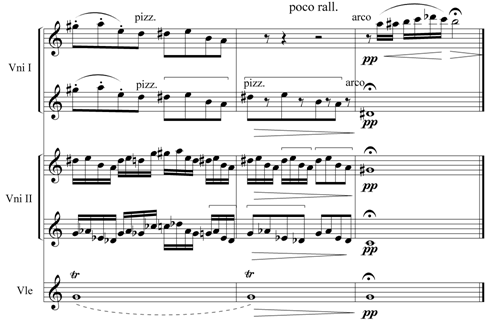
Mesto from part III (meas. 6), configured by a succession of minor, descending thirds (by addition, diminished intervals of fifth and seventh are obtained), in mixtures of minor sixths (which involves a false relation corresponding to parrhesia),
- Ex. 9. (3-1)

has a mirror response (meas. 30):
- Ex. 9 bis. (3-1 bis)

The Quasi recitative is introduced between the two moments, as an admirable example of unison (comparable only with the famous Prelude in Suite I op. 9 by Enescu). The surprise is offered by the intonations of the incipit, making an unexpected reference to the theme of the first movement in Symphony No. 8 by Schubert (!):
- Ex. 10. (3-3)

The example fits at least two of the four “aesthetic functions” of quotation, from Zofia Lissa’s point of view: 1. to symbolize an expressive characteristic (such as, for example, a state of mind), 2. to generate mental associations, 3. to suggest, more or less clearly, a situation, and 4. to produce parodic, ironic or grotesque effects (especially in vocal and theatrical works).
An exclamatio (Meno mosso, meas. 53), corresponding to the rhetoric of the spoken language, brings back the alternation between heterophony and unison:
- Ex. 11. (3-5)

Toccata, the movement in the finale of the concerto, configures metonymically, by the “genesis” of the rhythmical sequence of the semantron:
- Ex. 12. (4-1)

Then the dance rhythm (con slancio, meas. 41) [musical ex. 4-2], is followed by a medial Andantino and, after a new intervention of the rhythm of the semantron, by the reprise, ended paroxystically (climax).
Concerto for String Orchestra No. 2 by Toduţă unveils a rhetoric way of thinking, by which the figures, called by Umberto Eco “hyper-encoded syntagmas” , organize the aspects of discourse according to “identifiable intentions”, creating “contextual pressure” between messages.
From this perspective, the rhetoric becomes a “technique of the rational discursive interaction” and rhetoric figures surpass the stage of “pre-generated expressions”, contributing to the creation of unequivocal aesthetic meanings.